I spend a lot of time with clients talking about resources and resourcing. I don’t always use those exact words, but it’s the same idea in essence.
I want to spend some time explaining what I mean by this, since it’s often a topic that comes up early in our work.
First, what are resources? In this context, the meaning is broad. In essence, resources are the internal and external skills, abilities, items, feeling states, people, and more that we need to accomplish a particular goal.
For example, if my goal is to bake a cake, there are a number of resources that will be needed. The obvious ones are cake ingredients and kitchen utensils. But one also needs time, internal energy, baking experience or a willingness to try something new, desire to do it, willingness to follow through on that desire, health, physical stamina, and so on.
If a person has what they need materially but is lacking the willingness or ability to try something new, maybe there are other resources they could draw upon to close that gap. They could call a supportive friend. They talk about their desire to bake the cake, but admit that because they’ve never done it before, and because their boss yelled at them earlier that day for making a mistake, they’re struggling to find the gumption to risk spending all that time and all those ingredients on something that could turn out horribly. The friend offers encouragement, and helps the baker reconnect with their own courage to try new things, along with a shift in perspective: in the end, they really have little to lose by trying.
When I consider all the great epic stories, the protagonist sets out on a quest. Something they feel they need to do, compelling enough to pull them out of their comfort zone. Take Lord of the Rings. Frodo initially thinks he’s going to set off on this huge journey all by himself. But as the story goes, it quickly becomes clear he isn’t equipped with everything he needs to accomplish his goal. He needs more resources, which in his case come in the form of companions and objects gathered along the way. Some of those companions offer tangible resources, like knowledge of food sources or protection. Others offer courage, fortitude, tenacity, a grieving companion, and other emotional resources that turn out to be just as essential for completing his grueling quest.
I think of our clinical work in much the same terms. A client comes in and states their goal, freedom from viewing pornography, or relief from crippling anxiety. First, we take inventory of the resources already on board: community of support, emotional resilience, self-care practices, spiritual practices, financial stability, physical and emotional health, and so on. Once we know what’s already there, we can consider what’s missing, and start putting it in place as we head out on the journey together toward the goal.
Some resources are close to universal. Breath work is one of the most reliable I know, a slow, intentional breath can shift a nervous system in real time, and it costs nothing and requires no equipment. Movement, music, and time in nature tend to work broadly too, even if the specific song or trail differs person to person.
Other resources are much more particular to the individual, shaped by their own history, relationships, and quirks. A worn flannel that smells like a late grandparent. A specific verse of scripture. The particular calm of a particular cat curled on a particular lap. A cup of your favorite tea in the mug your friend made. These personal resources can’t really be prescribed, only discovered, and part of our work together is helping a client notice what already works for them, even when it looks nothing like what works for someone else.
Knowing that resources exist is one thing. Knowing what your options even are is another. I sometimes compare it to walking into a restaurant with no menu. You know you’re hungry, you know food is somewhere in the building, but without a menu in front of you, it’s hard to know what’s actually possible to order. You might default to the one dish you always get, not because it’s the best fit for tonight, but because it’s the only thing that comes to mind. A menu doesn’t tell you what to want. It just makes the range of what’s available visible, so you can find what actually fits.
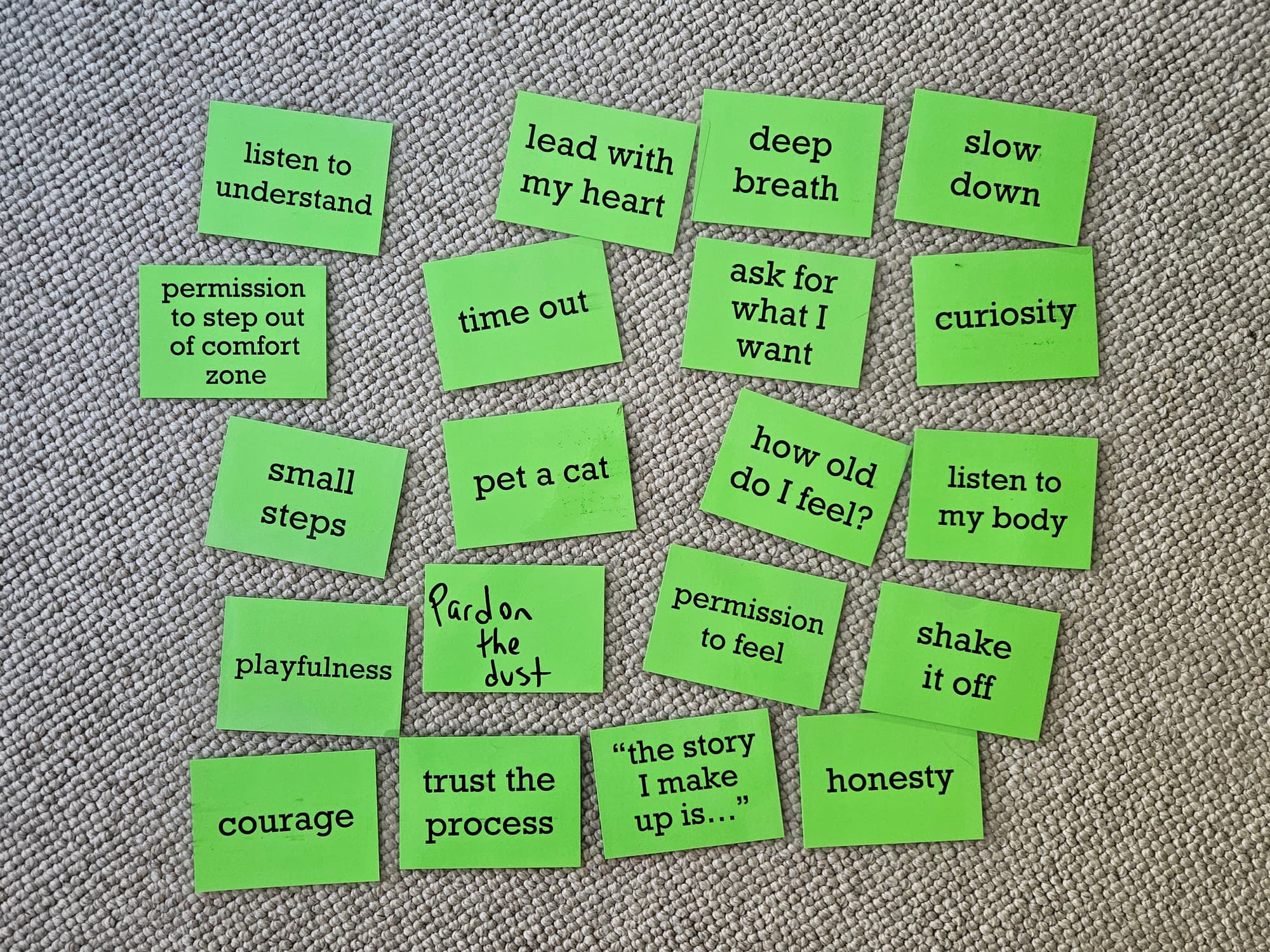
This is part of why I created a set of resource cards that I sometimes use with clients, a kind of menu of resources people can look through and consider. Some are almost universal: breathe, deep breath, slow down, small steps, gratitude, boundaries. Others point toward something more relational or communal: ask for help, community of support, supportive presence, trust the process. Still others point inward, toward a shift in stance rather than an action: permission to feel, progress not perfection, self-compassion, creative expression. And some are delightfully specific and embodied, like pet a cat, or listen to my body. Laid out together, they help someone see, often for the first time, just how many possible resources are actually on the table, and to notice which ones they’ve never even considered trying.
No amount of trying harder with the screwdriver will drive the nail into the wall.
Resources can be internal, like feeling states, memories, or a particular breath practice. Or they can be external, like people, pets, money, or health. Learning to take stock of both, what’s already present and what’s still needed, is often one of the first and most important steps of the work.