I recently had a tooth that got infected and needed to be removed. In concept this seems pretty straightforward, but as I got closer to the details, and the abstract concept on paper moved closer to my reality, my nervous system got more activated. I spent some time wondering where this was coming from, since I don’t recall ever having had any dental trauma, in fact, more the opposite. My childhood dentist was crazy generous with the nitrous oxide, which meant I loved going to the dentist. And my present dentist is one of the kindest, gentlest humans on the planet. When something like this doesn’t add up, I tend to hold it loosely in my mind, letting it turn over this way and that until some newfound clarity begins to emerge. In this case, in time, the puzzle pieces came together.
I often hear, “trauma? I was never beaten or sexually abused, or starving. My parents weren’t alcoholics. I had a normal childhood.” What people often don’t consider is that trauma can come about not only from what was done to you, but also from what was not done. Emotional neglect can be significantly traumatic. Say mom had a particularly rough experience of postpartum depression, or another major mental illness, or had to work several jobs just to pay the bills. That’s not that she screwed up her parenting, it was circumstances. But the motivating factors behind the absence of emotional support mean little to the child who comes home from school every day to an empty house, with no one to share their wonderful day or hard day with. When the parent gets home, there’s just enough time for a quick visit before bed.
Emotional neglect doesn’t leave visible scars on the body like abuse does. But it leaves scars on the heart.
As I pondered my experience with dental procedures, I remembered getting my wisdom teeth removed at fifteen. I had the choice of having the surgery done in the office, or going to the hospital to have it done in an operating room. Having heard about my brother’s experience having it done in the office, and knowing my fear of blood and guts, I chose the hospital option. The surgery on my teeth went fine, no problems, but my heart was another matter. Humans don’t experience surgery in an emotional vacuum. Preceding it and afterward, it will leave the person with a quagmire of emotions to process, even if they’re working hard not to feel them.
But what was missing was the emotional support. I have a distinct memory of walking into the hospital operating room. It was my first big surgery experience. The room was freezing cold, and I was in a thin hospital gown. Enormous lights loomed over the table like some kind of monster hovering over its prey. The sounds were strange, all sorts of beeping. Lots of people milling about, at least I think they were people, hard to tell with them being covered head to toe in hospital scrubs. Then there was an incredibly cold stainless steel table I was instructed to lie down on. My body was shaking like a fish out of water, partly from the cold, but also because I was terrified. And I had no internal resources for managing the situation. Same went for post-surgery recovery: spitting blood, feeling the pain, the nausea, all of it, with little regard for the emotional soundtrack of such an experience. Emotionally, I was alone. And overwhelmed.
We can’t change what happened. But maybe we can change how it impacts today.
Remembering that experience more honestly, I realized my adolescent self was activated, subconsciously thinking, oh shit, here we go again. This time, I had enough knowledge about what was happening for the puzzle pieces to come together. It made sense. And yet no matter what I did, I couldn’t seem to get emotionally regulated enough to get back to my secure adult self, who could then help my freaked-out adolescent self. In essence, my trauma-activated adolescent self was driving the bus, having tied the secure adult self up in the back seat. As the surgery date got closer, my anxiety increased.
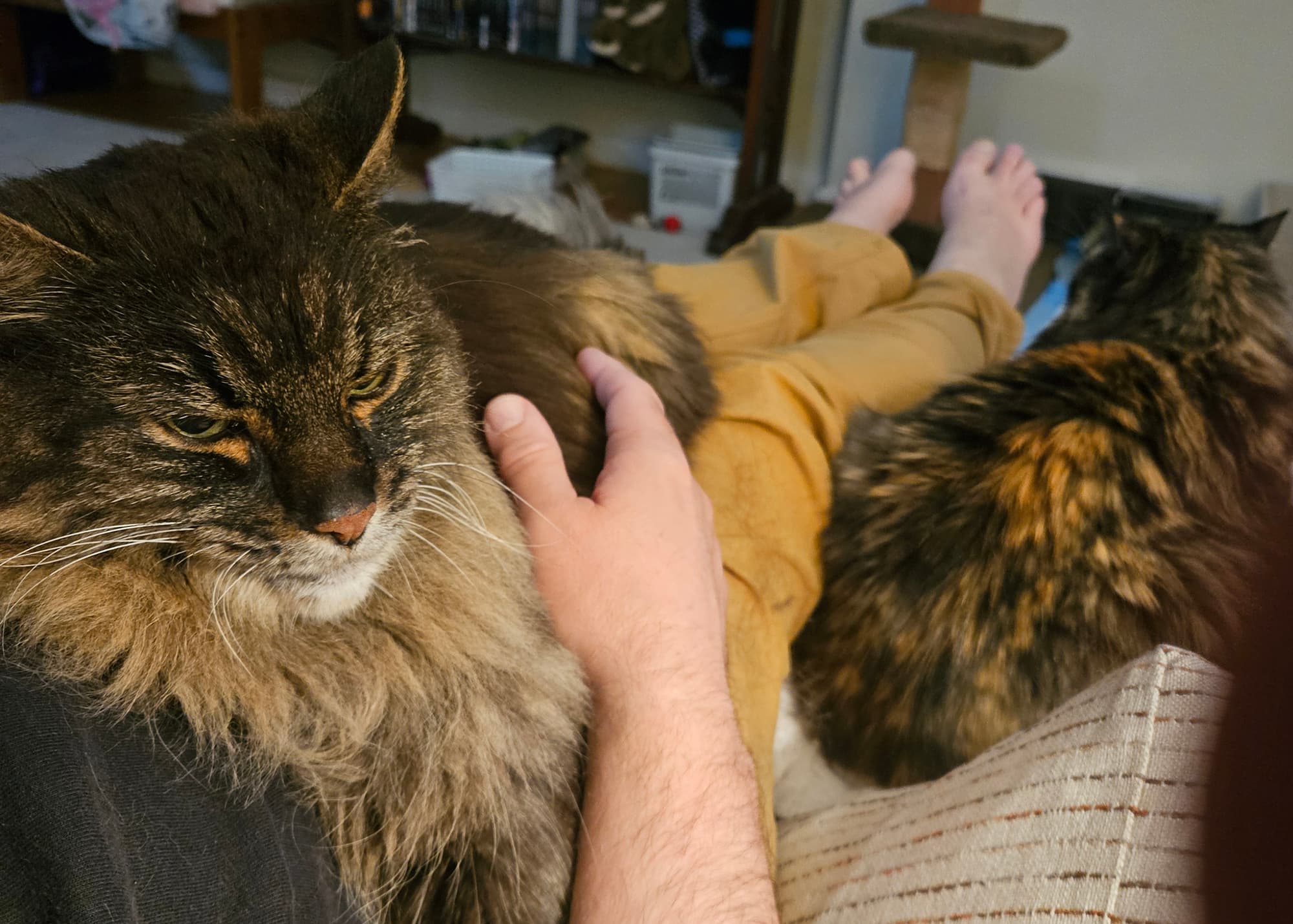
The morning of surgery, I had some time before I needed to leave. Not really knowing what to do with myself, awaiting my appointment with the torturer, I sat on the couch. After a few minutes of catastrophizing, Lucy hopped up to visit. Then Nahum, my eighteen-year-old cat, quickly followed. Nahum sprawled out across my lap, resting his head on my stomach, purring away. Lucy settled in beside me.
As I soaked in their love, I heard Nahum remind me that he’d had most of his teeth extracted over the years. It’s not a pleasant experience, but it’s also not the end of the world. In fact, he recovered quickly, and has had many great years with almost no teeth.
I felt understood and affirmed by someone who’d been there, done that. As I continued soaking up his calming energy, I realized I was regulated enough now to access my secure adult self. And with him back driving the bus, I could reach out to my terrified adolescent self and help him, offering him the calm presence and reassurance he’d never gotten and desperately needed. He settled. Nahum has a way of bringing comfort wherever he goes, he can’t help it, it’s simply his gift. He’s remarkably intuitive, always seeming to know exactly when a person, or a fellow cat, needs his gentle presence.
As I connected with him, I noticed he was really enjoying Nahum and Lucy’s company. So I decided to take a small clump of Nahum’s fur as a physical reminder of his comfort and resiliency.
When the nurse took me back to the room where the surgery would happen, the first thing she asked was what music I wanted playing. They want their patients as comfortable as possible, and one thing that helps is music. This caught me completely off guard. I had to work through my codependent part, which immediately popped up with the thought that we should play whatever music would make the surgeon most comfortable, since he’s the one wielding the sharp implements. Once I worked through that, I came back to my truth: Taylor. I wanted Taylor with me. For those who don’t know, music has been a huge, significant resource in my life. For the last few years, it’s been all about Taylor.
So let’s review the resources I had with me this time around that I didn’t have as an adolescent. I had a large community of support, people who know my story, people I’d been talking with about these fears. I had a grounded, chill cat who exudes calmness and comfort. I had the vicarious experience of others who’d had similar dental extractions. I had fur to hold in my hand, a tactile sensation connecting me right back to Nahum’s calm, comforting energy. I had Lucy’s calm presence. I had a deep sense of feeling loved and cared for by my higher power, having experienced my cats as ambassadors of that higher power on countless occasions. I had my person, emotionally present and available, drive me there, wait for me, and stay with me for the day post-surgery. And when I got there, I had Taylor. Through her music, I connected with lots of different emotional resources: resiliency, tenacity, courage, love, boldness, creativity, connection, embracing pain and discomfort as part of the human experience that, when leaned into, can lead to amazing places. Fun. Silliness. Playfulness. Relationship. The list goes on.
My life often feels like it’s lived in layers. There’s the current day thing I’m dealing with, and underneath it, the historical echoes of old trauma, quiet but insidious, waiting for the right key to turn. This wasn’t just a tooth extraction. It was also trauma work, happening alongside it, woven through it. I keep making progress, and keep experiencing the fruit of that growth, which I’m deeply grateful for.
This is what a corrective experience looks like: not erasing what happened at fifteen, but finally giving that scared kid what he needed all along.
Resources can be internal, like feeling states, memories, sensations. Or they can be external, like people, cats, money, health. This time, thankfully, I had both.